Wood rot is the slowest emergency a house has. It starts at one end of a piece of trim, behind a paint film that still looks fine, and works inward for years. By the time it is visible, the window sill, the corner board or the bottom of the door jamb is soft the whole way through and the sheathing behind it has been wet for seasons. In our climate, with the humidity and the afternoon rain, it is the most common exterior repair we do. The good news is that it is easy to catch early if you know where to look.
Where rot starts
- Window sills and the bottom of window trim. Water runs down the glass and sits on the sill. The joint between the sill and the side casing is the first place to fail.
- Bottoms of door jambs and brickmould. Splashback from the porch or the step keeps the bottom few inches wet.
- Corner boards near the ground and anywhere siding or trim touches concrete, a deck, or mulch.
- Fascia behind a leaking gutter and at the corners where gutters overflow.
- Trim around the garage door, which takes both splash and the sun.
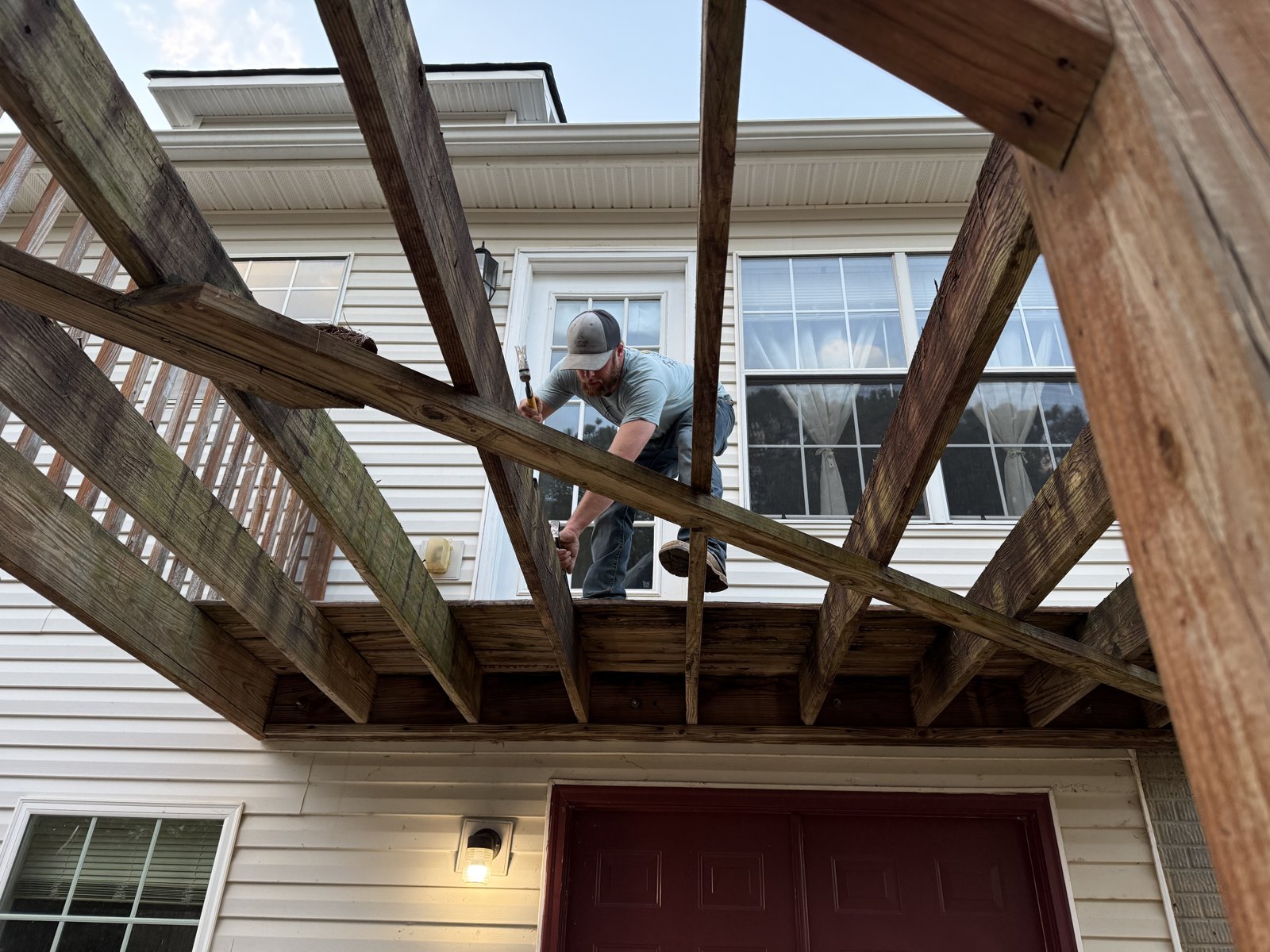
- Deck ledgers and railing posts. Covered in our deck repair post.
- Anywhere the caulk failed at a joint between two pieces of trim or between trim and siding.
How to find it
Walk the outside of the house once a year, ideally after a rain, with a screwdriver or an awl.
- Probe. Push the tip into the trim at the end grain and the bottom edge. Sound wood resists; rotten wood lets the tip sink with no effort.
- Look for paint that is bubbling, cracking, or lifting in a pattern that follows the grain. The wood underneath is moving because it is wet.
- Look for dark staining, green algae, or fungal growth at joints and bottoms.
- Press with a thumb. Soft, spongy wood under paint that looks fine is rot.
- Check the sheathing if the trim is already gone. Once trim is off, the wall behind it tells you how long the water has been getting in.
Repair or replace
Epoxy repair is right for small areas of rot in a piece that is expensive or awkward to replace: a section of a window sill, the bottom of a decorative column base, a spot on a historic piece of trim in one of the older Newnan neighbourhoods. The soft wood is removed, the area is treated with a consolidant, filled with a structural epoxy, shaped, primed and painted. Done well, it outlasts the surrounding wood.
Replacement is right when the rot runs more than a few inches, when the piece is a standard profile, or when the piece is structural, like a door jamb or a post. A rotten section is cut back to sound wood and a new piece is scarfed in, or the whole board is replaced.
What to replace it with
- Cellular PVC trim. Cannot rot, takes paint, cuts and installs like wood. Our default for sills, corner boards, brickmould and any trim near the ground or exposed to splash. It expands with heat, so joints are glued and it is fastened accordingly.
- Composite or fibre cement trim. Rot-proof and stable, works well with fibre cement siding.
- Primed wood. Fine where it is protected by an overhang and back-primed before installation. Every cut end sealed.
- Never bare or unprimed pine on an exposed face. It starts rotting the first season.
The repair itself
- 1Remove the rotten piece and check the sheathing and framing behind it. Repair those first if they are soft.
- 2Add or repair the flashing: a drip cap over windows and doors, flashing tape on the sheathing, a kerf or a slope so water sheds.
- 3Install the new piece, back-primed or PVC, with corrosion-resistant fasteners.
- 4Caulk the joints with an exterior sealant, not painter's caulk; our caulk post covers which one.
- 5Prime and paint to match. Paint is the water barrier on wood, and the top and bottom edges matter most.
Questions we get
Can I just paint over it?
Paint over rot seals the water in and hides the problem for a year. The wood keeps rotting underneath.
Is rot covered by insurance?
Generally not; it is considered maintenance. Sudden water damage from a storm or a burst pipe is a different matter. Our storm damage post covers that.
Is this a handyman job?
A few pieces of trim, a sill or a jamb bottom are a normal handyman visit. A wall's worth of siding and sheathing is a bigger project, and we will tell you which one you have.
Get it looked at before it spreads
Wright Way Services repairs rotten trim, sills and siding across Newnan, Peachtree City, Sharpsburg, Senoia, Tyrone and Fayetteville. Call (770) 301-4638 or request service.
Open 24 hours · Newnan, GA
Want a hand with this one?
Wright Way Services handles it all in one call — plumbing, remodeling, smart home installs and the whole punch list. Serving Newnan, Coweta County and the surrounding area.