Every few winters a cold front drops out of the Midwest, parks over north Georgia for three days, and we spend the following week cutting drywall out of ceilings in Newnan, Sharpsburg, and Peachtree City. The homeowners are always surprised. They shouldn't be. Georgia houses burst pipes more readily than houses in Minnesota do, and the reason is not the weather.
It's the construction. In a climate where a hard freeze is a once-every-few-years event, nobody builds for it. Water lines get run through vented crawlspaces, through exterior wall cavities behind a half inch of sheathing, along the ceiling of an unheated garage, and sometimes straight through an attic to feed a second-floor bath. None of that is illegal and none of it matters at 40 degrees. At 18 degrees with a north wind, it is a list of the exact places your pipe is going to split.
What Actually Happens Inside the Pipe
Water is strange. Most things shrink when they get cold; water expands about nine percent when it turns to ice. That expansion inside a sealed copper or PEX line generates enormous pressure, and here is the part most people get wrong: the pipe usually does not split at the ice.
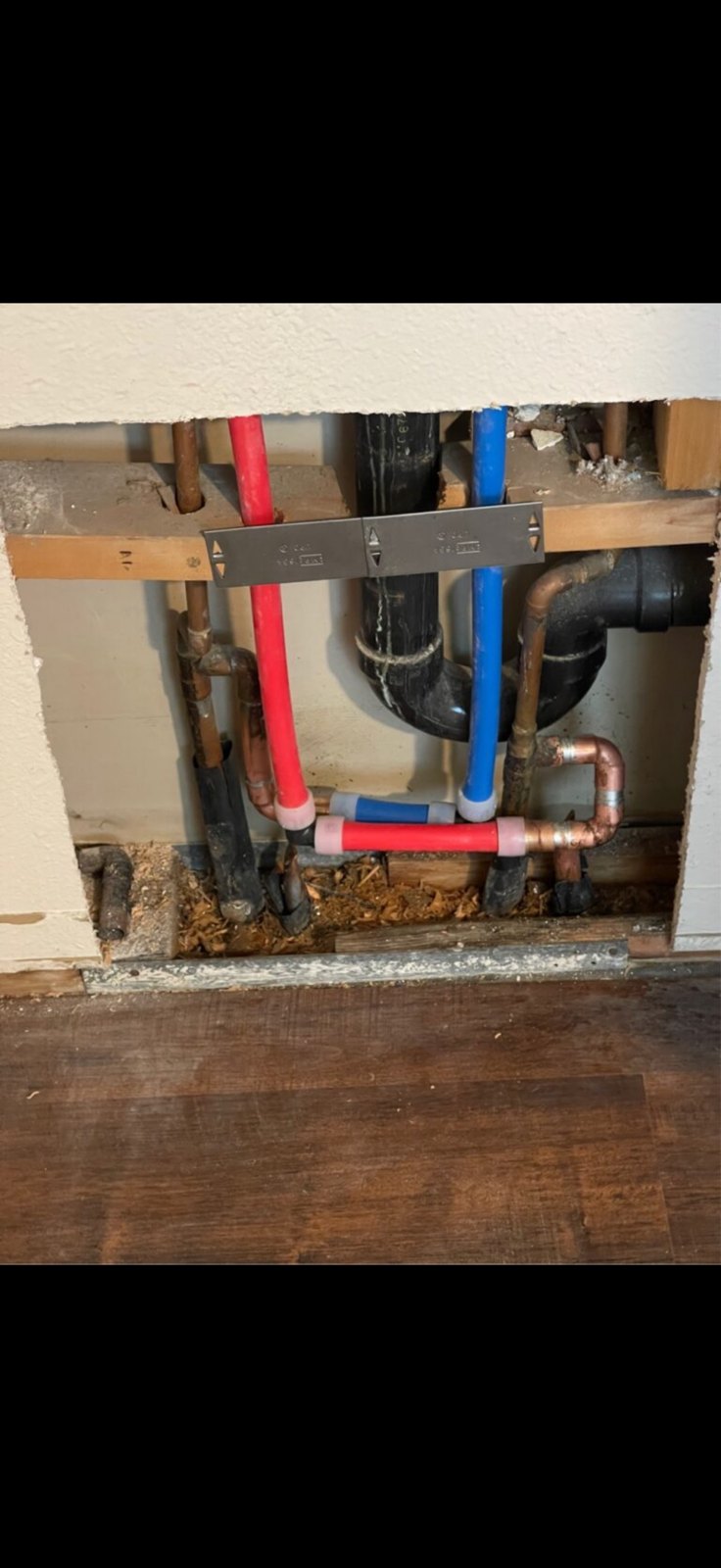
An ice plug forms at the coldest point, often where a line crosses a crawlspace vent or an uninsulated rim joist. As that plug grows, it pushes water ahead of it down the line. If there is a closed faucet or a closed valve downstream, that water has nowhere to go. Pressure builds in the trapped column between the ice and the closed fixture until the weakest point in that stretch fails. That is why a burst can show up ten feet away from the frozen section, in a spot that never got below 40 degrees.
The second thing people get wrong is the timing. The split happens during the freeze, but the flood happens on the thaw. Ice is still plugging the hole. When the sun comes out on day three and everybody relaxes, the plug melts and the line dumps at full house pressure into a wall cavity. If nobody is home, it runs for hours.
The Pre-Freeze Checklist
When the forecast says a hard freeze, work this list. It takes about half an hour and it prevents almost every burst we get called out for.
- Disconnect every hose. This is the single biggest one. A hose left attached to a spigot holds water against the valve and defeats a frost-free sillcock entirely. Drain the hose and coil it up.
- Drain and cover the hose bibs. After disconnecting, open the spigot for a moment to let it drain back, then close it and slip an insulated foam cover over the head.
- Insulate exposed lines. Foam pipe sleeve on any water line you can physically touch in the crawlspace, garage, or attic. Pay attention to the first few feet where the line leaves the water heater and the sections running along an exterior foundation wall.
- Close the crawlspace vents. Those vents exist to move air. In a freeze, they are pointing 18-degree wind directly at your supply lines. Close them or block them with rigid foam board cut to fit.
- Open the cabinet doors under any sink on an exterior wall, especially a kitchen sink under a window. That lets house heat reach the supply lines inside the cabinet.
- Keep the thermostat steady. Do not set it back at night during a freeze event. A constant 65 beats a swing between 70 and 58.
- Know where your main shutoff is. Before you need it, not during.
Dripping Faucets: Which Ones, and Why
"Leave a faucet dripping" is common advice and it is mostly right, but the details matter. The point of the drip is not that moving water can't freeze. It can. The point is that an open faucet relieves the pressure buildup between the ice plug and the fixture. That trapped pressure is what splits the pipe, and an open path to atmosphere means there is nothing to build.
So drip the fixture that is farthest from the water heater along the longest run, which is usually a bathroom at the far end of the house or a laundry sink in the garage. And open both handles, hot and cold. Cold lines freeze first, but your hot line runs through the same joists and the same crawlspace, and a frozen hot line is just as expensive. A steady drip, not a stream. Roughly the pace of a slow tick.
Frozen But Not Burst: What to Do
You turn on a tap and get a dribble or nothing. That is a frozen line, and you have a short window to thaw it before it splits.
- 1Leave the faucet open. Open both handles. As the ice melts, the flow gives it somewhere to go and tells you the moment it clears.
- 2Find the cold spot. Follow the line back from the dead fixture toward the heater. Look at the crawlspace, the garage ceiling, the exterior wall. Feel for a section that is noticeably colder or frosted.
- 3Thaw it gently with a hair dryer, a heat gun on low, or a space heater aimed at the area. Work from the faucet side back toward the frozen section so meltwater can escape.
- 4Never use a torch, a propane heater, or an open flame. You will start a fire in a joist bay, and if the pipe is copper you can boil the trapped water and blow the line apart.
- 5Once flow returns, check every fixture in the house and look under the sinks and in the crawlspace for drips. A hairline split will not show itself until pressure is fully back.
The Sillcock Nobody Thinks About
Frost-free sillcocks are the exterior spigots with a long stem, so the actual valve seat sits 8 to 12 inches inside the heated wall instead of out in the cold. They work well. They fail for exactly one reason: somebody left a hose attached.
With a hose on, the barrel can't drain back after you shut the water off. Water stays sitting in that long tube, freezes, and splits the copper inside the wall. You will not know it happened. The spigot will look fine and work fine all winter. Then in April you turn it on to wash the truck and water pours into your dining room, because the split is behind the drywall and only leaks while the valve is open. We see a run of those calls every spring across Coweta County, and every one of them traces back to a garden hose in December.
Ready Before the Next Cold Snap
If you are not sure what is running through your crawlspace, whether your hose bibs are frost-free, or where your main shutoff actually is, have someone look before the forecast makes it urgent. We can walk the crawlspace, sleeve the exposed lines, replace a failed sillcock, and show you your shutoff so you are not hunting for it in the dark. And if a line has already let go, we answer around the clock. Call Wright Way Services at (770) 301-4638 and we will get the water stopped.
Open 24 hours · Newnan, GA
Want a hand with this one?
Wright Way Services handles it all in one call — plumbing, remodeling, smart home installs and the whole punch list. Serving Newnan, Coweta County and the surrounding area.