A dripping faucet is the plumbing call people put off longest, because it feels small. It is not small on the water bill, it is not small on the finish of the sink, and on a hot-water drip you are paying to heat water that goes straight down the drain. The good news is that it is one of the more predictable repairs in a house, and the decision between fixing and replacing usually takes about two minutes once you know what you are looking at.
Why faucets drip
Almost every modern faucet controls water with a cartridge, a ball, or a ceramic disc. Older two-handle faucets use rubber washers on a stem. Every one of those parts wears, and the wear shows up as a drip from the spout or a seep around the base of the handle.
- Drip from the spout when the faucet is off: the cartridge, washer or seat is no longer sealing. This is the most common failure and the most repairable.
- Water around the handle base: the O-rings or the cartridge body seals are gone. Usually still repairable.
- Water under the sink: supply line, connection nut, or a cracked faucet body. A cracked body is a replacement.
- Drip from the spout on a pull-down kitchen faucet: often the spray head or the hose connection rather than the cartridge. Check that first.
Hard water speeds all of this up. Mineral scale scores the seals and roughens the seats, which is why faucets in our part of Georgia tend to need attention sooner than the manufacturer would suggest. If you have noticed white crust around the aerator, that is the same problem. Our post on hard water in Newnan covers what it is doing to the rest of the house.
When a cartridge fixes it
If the faucet is a recognisable brand, the finish is still good, and the body is not corroded, a new cartridge is the right call. The major brands make replacement cartridges for decades and the repair takes well under an hour when the part is in hand.
The two things that turn a quick cartridge swap into a longer job:
- Identifying the cartridge. There are hundreds. The brand and model are sometimes printed under the handle or on the supply lines, sometimes nowhere. Bringing the old cartridge to the counter is the reliable method, which means the faucet is out of service while you shop.
- A seized cartridge. Years of scale can lock a cartridge into the faucet body. There are puller tools for the common brands, and forcing it without one usually cracks the body, which converts a repair into a replacement.
When replacing is the better answer
- The finish is peeling or pitted. A repaired faucet that looks worn is still a worn faucet.
- It is an off-brand or builder-grade unit with no cartridge available. A replacement often costs about what a hunt for parts would.
- The body is corroded or cracked, or the mounting nuts under the sink have rusted to the point that the faucet is loose in the deck.
- The shutoff valves and supply lines are also old. If they need replacing anyway, doing the faucet at the same time is the efficient sequence.
- You were going to change it eventually. A drip is a reasonable excuse to get the faucet you actually want.
What a faucet swap involves
The faucet itself is usually the easy part. Underneath is where the time goes: rusted mounting nuts in a cramped cabinet, stops that will not close, supply lines that are the wrong length for the new unit, and a sink deck with a different hole count than the faucet you bought.
Check the hole configuration before buying. A single-hole faucet can often go onto a three-hole sink with a deck plate; a three-hole faucet will not go onto a single-hole sink. Kitchen faucets with a separate sprayer or soap dispenser need their own holes too.
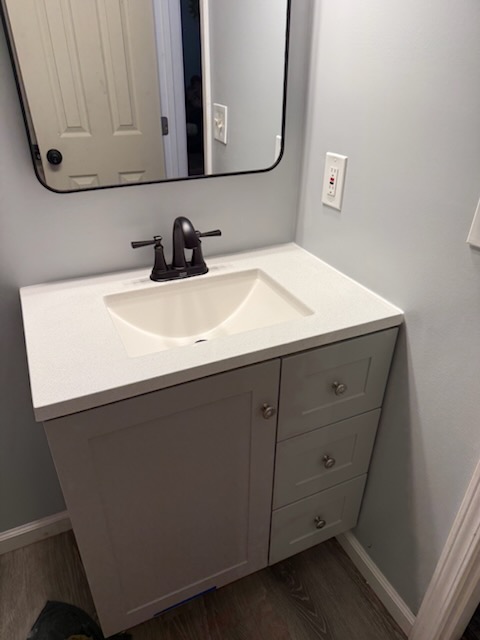
We swap faucets as part of a normal handyman visit and as part of plumbing calls, and we usually replace the supply lines and stops at the same time when they are the original builder parts. It costs a little more that day and it saves a second trip under the sink.
Questions we get
Can I just tighten the handle?
Tightening the handle on a cartridge faucet does nothing for a spout drip. On an old compression faucet it may stop the drip briefly by crushing the washer harder, which also finishes the washer off.
Is the drip why my water bill went up?
A steady drip adds up over a month but it is rarely the whole story. If the bill jumped noticeably, read our post on finding a hidden leak before blaming the faucet.
Do you bring the faucet or do I buy it?
Either works. If you have a specific finish in mind, buying it yourself is usually the better path. If you just want something solid that matches, tell us the sink and we will handle it.
Get the drip fixed
Wright Way Services repairs and replaces faucets across Newnan, Peachtree City, Sharpsburg, Senoia, Tyrone and Fayetteville. Call (770) 301-4638 or request service online.
Open 24 hours · Newnan, GA
Want a hand with this one?
Wright Way Services handles it all in one call — plumbing, remodeling, smart home installs and the whole punch list. Serving Newnan, Coweta County and the surrounding area.