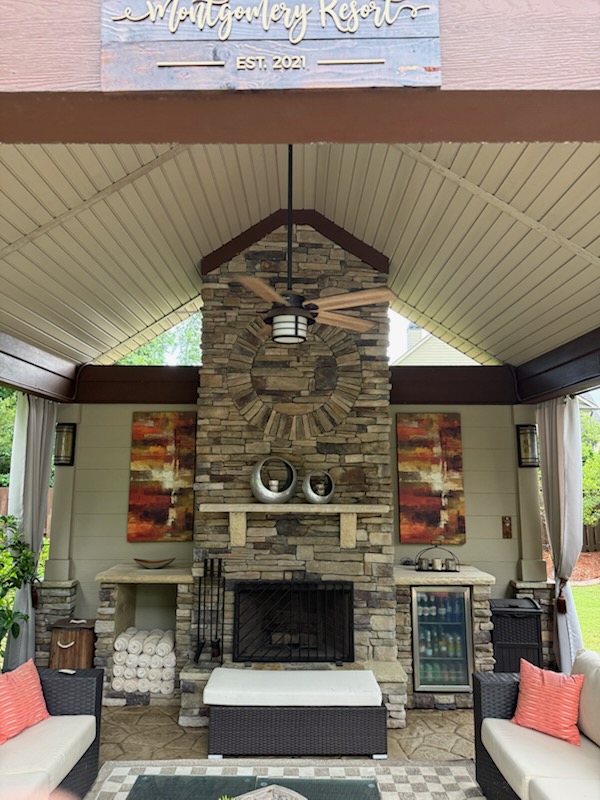
Both add usable space to the back of a house and both get called the same thing by homeowners. They are quite different projects with different costs, different permitting, and different answers to the question of when you can actually sit in them.
The screened porch
A roofed structure with screened openings rather than glass. Open to outside air.
Where it wins:
- Cost. Meaningfully cheaper than a sunroom for the same footprint.
- Bugs. Georgia mosquitos are the reason most people want one, and this solves it completely.
- Breeze. On a pleasant evening it is more comfortable than any enclosed room because the air moves.
- Simpler permitting, since it is generally not conditioned space.
- Rain. You can sit out through an afternoon storm, which is a genuinely underrated pleasure here.
- Less structural demand than a fully enclosed addition.
Where it loses:
- Unusable on the hottest and coldest days without adding heat or fans.
- Pollen still gets through screen, which matters in a Georgia spring.
- Furniture is exposed to humidity and blown rain.
- Does not add to conditioned square footage for appraisal purposes.
The sunroom
A fully enclosed room with glass walls. Whether it is climate-controlled is the key variable and it changes the project entirely.
Where it wins:
- Year-round use when it is conditioned.
- Sealed from bugs, pollen and weather.
- Furniture and finishes can be interior-grade.
- Adds conditioned square footage if built to the same standard as the house, which matters for appraisal.
- Views without the screen mesh.
Where it loses:
- Cost — substantially more than a screened porch.
- Heat gain. Glass plus Georgia summer sun is a real engineering problem. Without proper glazing and shading a sunroom becomes an oven, and this is the most common disappointment we see.
- HVAC. Tying into the existing system frequently overloads it; a dedicated mini-split is often the right answer and it is an added cost.
- Permitting and energy code apply fully if it is conditioned space.
- No breeze, which is the thing people actually enjoy about being outside.
The middle ground: a three-season room
Enclosed with windows but not connected to the home's HVAC. Sealed against bugs and pollen, protected from weather, usable most of the year, and considerably cheaper than a conditioned sunroom.
Add a ceiling fan for summer and a small heater for winter and the usable window widens a lot. For many Coweta County homes this is the best value of the three.
Another practical option: build a screened porch with a structure designed to accept glass panels later. Many systems allow swapping screen for glass seasonally or converting entirely down the line.
Permits and structure
Both require permits in Coweta County. A sunroom brings additional requirements because it is habitable space — energy code, egress, electrical and often HVAC.
Structural considerations either way:
- Foundation. A slab, piers or a framed floor, and it must be designed for the load. This is not a deck.
- Roof tie-in. How the new roof meets the existing one determines whether it leaks. This is the detail that goes wrong most often.
- Attachment and flashing at the house wall.
- Drainage so you have not just created a place for water to collect against the foundation.
- Setbacks. Confirm your lot allows the footprint before designing it.
Which adds more value?
A well-built sunroom that is conditioned and finished to the standard of the rest of the house adds to appraised square footage. A screened porch does not, though it absolutely adds to how the house shows and how much buyers want it.
A poorly built sunroom — obvious add-on, mismatched roofline, no climate control — can subtract value. Quality and integration matter more than category here.
How to decide
- Want it in July and January? Sunroom, conditioned.
- Want to sit outside without mosquitos on spring and fall evenings? Screened porch.
- Want most of the year on a moderate budget? Three-season room.
- Want the breeze? Screened porch, and nothing else will satisfy you.
- Need the square footage to count? Conditioned sunroom, built to code.
Talk it through
Wright Way Services builds porches, three-season rooms and additions across Newnan, Peachtree City, Senoia, Sharpsburg and Fayette County. Call (770) 301-4638 and we will walk the space with you.
Open 24 hours · Newnan, GA
Want a hand with this one?
Wright Way Services handles it all in one call — plumbing, remodeling, smart home installs and the whole punch list. Serving Newnan, Coweta County and the surrounding area.