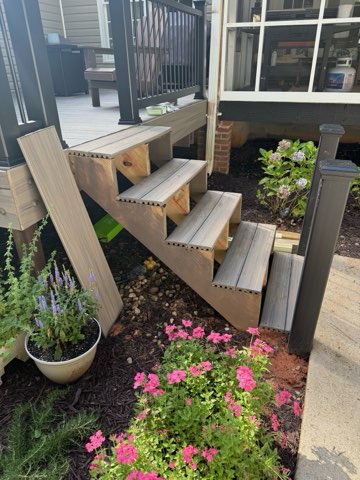
A deck looks like the simplest project on a remodeling list. It is outside, it is mostly straight cuts, and everybody knows somebody who built one. It is also the residential structure that fails most often, and the failures are dangerous because decks are usually full of people when they collapse.
Two details account for nearly all of it: how the deck attaches to the house, and what it sits on.
You need a permit
Deck construction in Coweta County and the City of Newnan requires a permit for anything beyond a very small ground-level platform. Check the specific thresholds with the building department for your jurisdiction — they differ, and they change.
Skipping it causes real problems later:
- Failed home sale. Unpermitted structures show up in inspection and title work, and buyers walk or demand it be brought up to code at your expense.
- Insurance exposure. If someone is injured on an unpermitted structure, expect the claim to be scrutinized.
- Forced removal or retroactive permitting if code enforcement gets involved.
- No inspection. The inspection is the thing that catches the ledger and footing mistakes that make decks fall down.
Our guide on when you need a permit covers the broader picture.
The ledger board is where decks fail
The ledger is the board that attaches the deck to the house. When decks collapse, this connection is almost always the reason.
What has to be right:
- Lag screws or through-bolts into the rim joist, sized and spaced to code. Not nails. Nails pull out under load, and a deck full of people is a lot of load applied dynamically.
- Flashing above and behind the ledger so water cannot get behind it. Without flashing the rim joist rots quietly for years and then the whole assembly lets go.
- Attachment to solid framing, not to brick veneer, not to siding, not to a cantilevered floor.
- No attachment through stucco or veneer without proper detailing.
Footings and Georgia clay
Georgia red clay expands when wet and shrinks when dry. A footing that is too shallow moves with it, and a deck that moves tears itself apart at the connections.
Footings must go below the frost line and bear on undisturbed soil, sized for the load they carry. On clay that means paying attention to depth and bearing area rather than pouring the minimum.
The inspection covers this, which is another argument for the permit.
Material comparison
Pressure-treated pine
The value option and by far the most common. Cheapest up front, readily available, and it works. Requires cleaning and re-sealing every couple of years, and it will cup, check and split over time in the Georgia sun. Expect real maintenance.
Cedar
Naturally rot and insect resistant, stable, attractive. More expensive than treated pine and still needs sealing to hold its colour, though it weathers to grey gracefully if you let it.
Composite
Wood fibre and plastic. No sealing, no staining, no splinters, and it holds its appearance. Significantly more expensive up front and the lifetime maths usually favours it if you plan to stay in the house. Note that composite gets hot in full Georgia sun — worth considering for a deck with no shade.
PVC
Fully synthetic, the most weather-resistant option, lightest and most expensive. Cooler underfoot than most composites.
Whichever surface you choose, the framing underneath is pressure-treated lumber in essentially every case. The material decision is about the deck boards and railings.
What drives cost
- Size, obviously — priced largely by square foot.
- Height off the ground. A deck 8 feet up needs bigger posts, more bracing, guardrails, and often stairs with landings. Height costs far more than plan area.
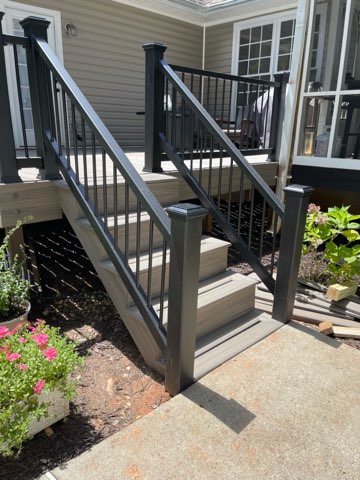
- Stairs. Expensive per step and a code-heavy element — rise, run, handrails and guards all inspected.
- Railings. Can be a meaningful share of the total, particularly cable, metal or glass systems.
- Material choice across the whole surface.
- Site access and grade. A steep or tight backyard slows everything down.
- Footings, especially where depth or soil conditions require more concrete.
- Extras — built-in benches, planters, lighting, screening, roof.
Plan for how you will use it
The most common regret is a deck that is too small for a table with chairs pulled out. Measure your actual furniture and add circulation space around it. A deck you cannot walk around a seated guest on is a deck people avoid.
The second most common regret is no shade. West-facing decks in Georgia are unusable on summer afternoons without a pergola, sail or roof. Design for that from the start rather than adding it later.
Get it built right
Wright Way Services builds decks, stairs and railings across Newnan, Sharpsburg, Senoia, Peachtree City and Fayette County — permitted, inspected and detailed to last. Call (770) 301-4638.
Open 24 hours · Newnan, GA
Want a hand with this one?
Wright Way Services handles it all in one call — plumbing, remodeling, smart home installs and the whole punch list. Serving Newnan, Coweta County and the surrounding area.