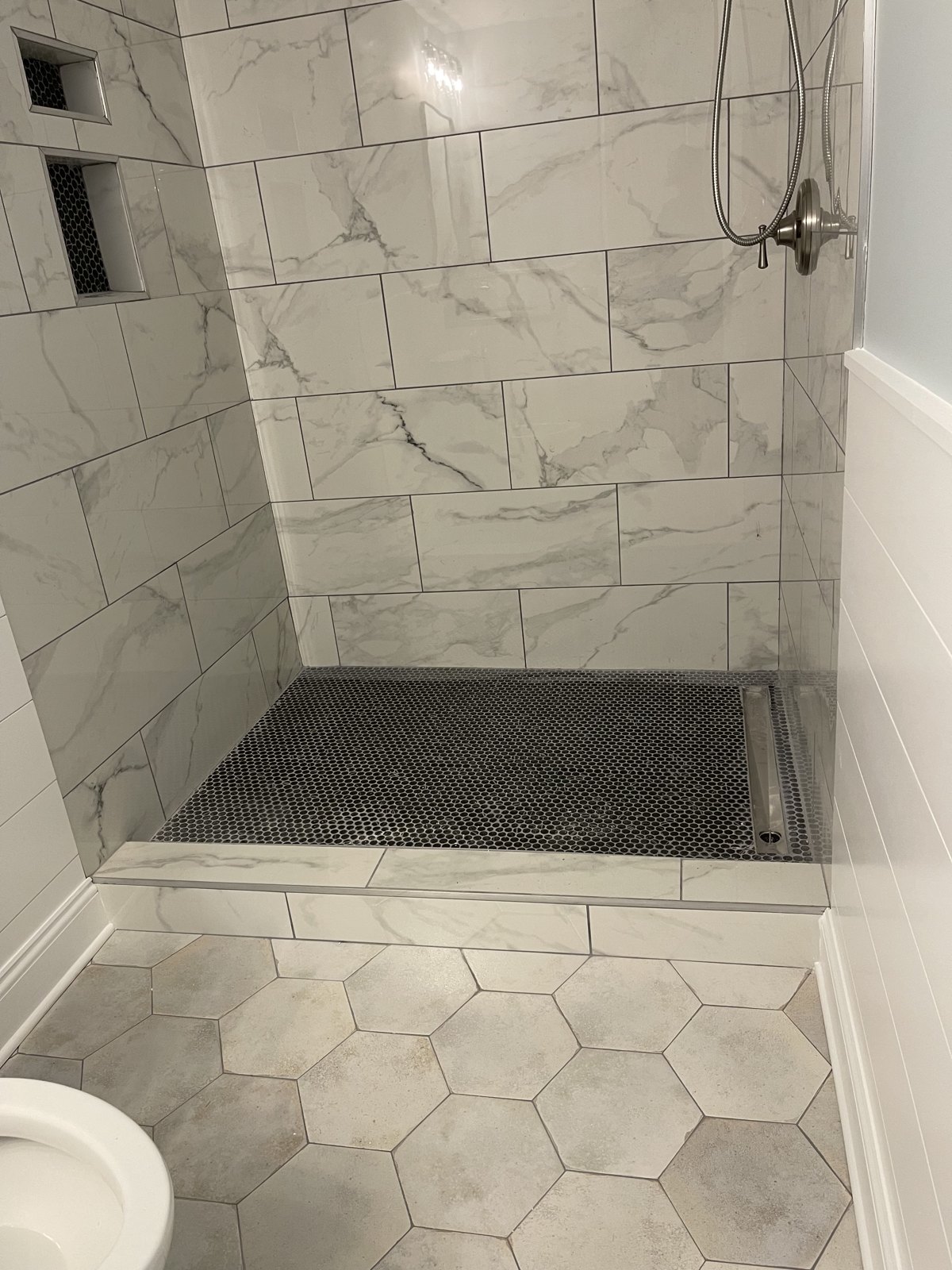
A bathroom is the smallest room in the house and one of the most complicated to rebuild. Every trade touches it. Water, drain, vent, power, framing, structure, tile, glass, and finish carpentry all land inside a space you can cross in two steps. That's why a bathroom takes longer than people expect, and why the cheap version fails. Here's what actually happens, in order -- and what the crew is doing when it looks like nothing is happening.
Phase 1: Demo
Everything comes out. Tile, tub or shower pan, vanity, toilet, drywall down to the studs in the wet areas, and usually the floor down to the subfloor. Protection goes down on the path from the door to the truck, and containment goes up so drywall dust doesn't end up in your HVAC returns. Demo is also the day you find out what's really behind the wall -- more on that below.
Phase 2: Rough Plumbing and Rough Electrical
With the walls open, the plumber sets the drains and supply lines, sets the shower valve to the right depth for the finished wall thickness, and lands the tub or shower drain exactly where the fixture needs it. If the vanity is moving or growing to a double, that's new supply and new drain.
The electrician runs the circuits: GFCI protection, vanity lighting, a wet-rated fixture in the shower if there is one, the exhaust fan, and a dedicated line for a heated floor. This is the only chance to add a circuit without opening the wall back up -- so it's also the moment to say yes to that outlet inside the vanity.
Phase 3: Inspection
Rough plumbing and rough electrical get inspected before anything covers them, and nothing goes back on the walls until the inspector signs off. Inspections have to be scheduled, which means your calendar now depends partly on somebody else's. This is a normal, healthy dead day -- not a crew slacking off.
Phase 4: Insulation, Backer Board, and Waterproofing
Exterior walls get insulated. Then backer board goes up in the wet areas -- cement board or a foam board system, not drywall and never green board behind tile.
Then comes waterproofing, and this is the part cheap jobs skip. A tile shower is not waterproof. Tile isn't waterproof, grout isn't waterproof, and thinset isn't waterproof. Water gets through all of it. What keeps the water out of your framing is a waterproofing membrane -- either a liquid-applied membrane rolled onto the backer board or a bonded sheet membrane -- with every seam, corner, and pipe penetration sealed. On the floor of a mud-set pan, there's a pre-slope under the liner so water that reaches the liner still runs to the drain instead of sitting in the pan.
Skip the membrane and the shower will look perfect for a while. Then the grout starts staining, then the tile in the corner sounds hollow, then somebody notices the ceiling below is soft. Rebuilding a rotted shower is a lot more expensive than waterproofing one.
Phase 5: Tile
Layout gets snapped first -- where the cuts fall, whether the pattern is centered on the wall or the drain, how the tile meets the ceiling and the corners. A good tile setter spends real time on layout before the first tile goes up, because layout is what separates a professional job from an obviously amateur one.
Then tile goes up. Then it cures. Then grout goes in, and that cures before it gets sealed or gets wet. Cure time is chemistry, not laziness. You cannot rush mortar or grout, and pushing on it is how you get cracked joints and loose tile.
Phase 6: Drywall, Paint, and Trim Out
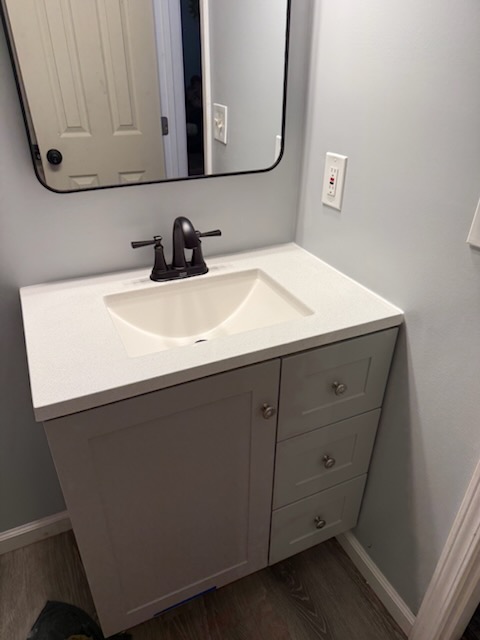
Drywall goes back on the non-wet walls and gets taped, floated, sanded, and primed. Paint goes on before the fixtures so nobody is cutting in around a new faucet. Then the trim out: set the vanity and top, mount the faucet, set the toilet on a fresh seal, hang the mirror and lights, install the fan cover and door hardware, and mount towel bars into the blocking that went in back at phase 4. This is the week it suddenly looks like a bathroom again.
Phase 7: Glass, Punch List, Final Inspection
Custom shower glass is measured after the tile is finished, because it's cut to the opening as built, not as drawn. It's ordered late by necessity, and then there's fabrication lead time on top. If your schedule shows a gap between the tile finishing and the glass showing up, that gap is real and unavoidable.
Punch list is the small stuff -- a caulk line, a touch-up, a door that needs adjusting. Then the final inspection, and you're done.
What We Find After Demo in Older Newnan Homes
A lot of the housing stock around Coweta County -- the older neighborhoods in Newnan proper, out toward Sharpsburg and Senoia -- has bathrooms that have been leaking quietly for a long time. Common finds:
- Rotted subfloor under the toilet. A toilet flange that's been weeping for years turns the subfloor to mush. You can't set a new toilet on rotten wood, so the subfloor gets cut out and replaced.
- No insulation in the exterior wall. Common in older construction. Cheap and easy to fix while the wall is open, and you'll feel the difference in a Georgia January.
- Undersized or corroded supply lines. Old galvanized pipe chokes down with corrosion over decades. If it's exposed, it's the right moment to replace it.
- An exhaust fan vented to nowhere. The fan runs, the noise happens, and every bit of that humid air gets dumped into the attic where it condenses on the sheathing. In our humidity that's a mold problem waiting to happen. It gets ducted to the outside.
- Failed or absent waterproofing behind the old shower, with wet framing to prove it.
None of these are anybody's fault. They're what happens when a house is thirty or fifty years old. The right response is a contractor who tells you what they found, shows you, and prices the fix honestly instead of tiling over it.
So How Long Does It Take?
It depends on scope, and any contractor who gives you a number before knowing the scope is guessing. The things that stretch a bathroom timeline: whether plumbing is moving, whether the shower is a pan-and-tile build or a prefab unit, whether custom glass is involved, whether special-order tile or a special-order vanity has a lead time, how many inspections the scope triggers, and what demo uncovers. A cosmetic refresh and a full gut with a relocated shower are not the same job and won't share a calendar.
Get a Straight Answer About Your Bathroom
If you want to know what your bathroom actually needs -- and what a real timeline looks like for your specific scope -- have somebody walk it with you. Wright Way Services is in Newnan and we're reachable around the clock at (770) 301-4638. We'll tell you what's behind the tile before you commit to anything.
Open 24 hours · Newnan, GA
Want a hand with this one?
Wright Way Services handles it all in one call — plumbing, remodeling, smart home installs and the whole punch list. Serving Newnan, Coweta County and the surrounding area.